On this page
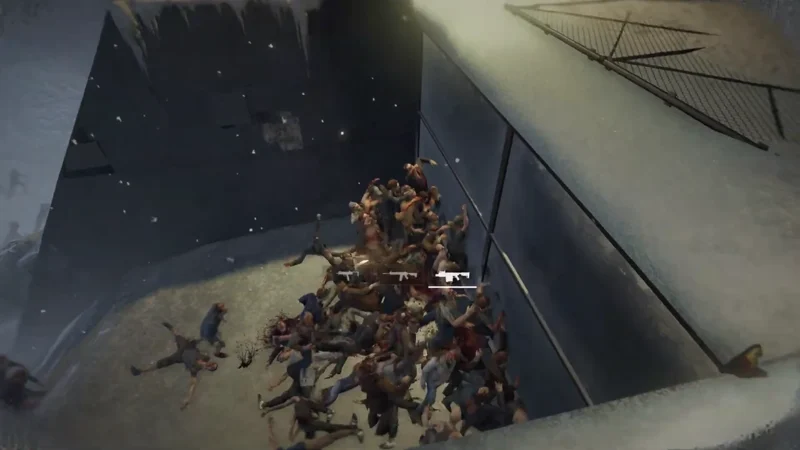
In World War Z, the infected at the foot of a wall are climbing over one another. The pile is getting closer to the ledge where the player stands.
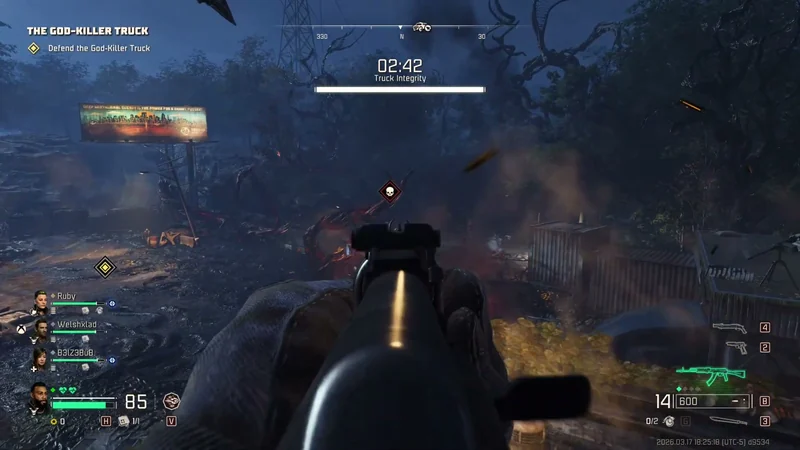
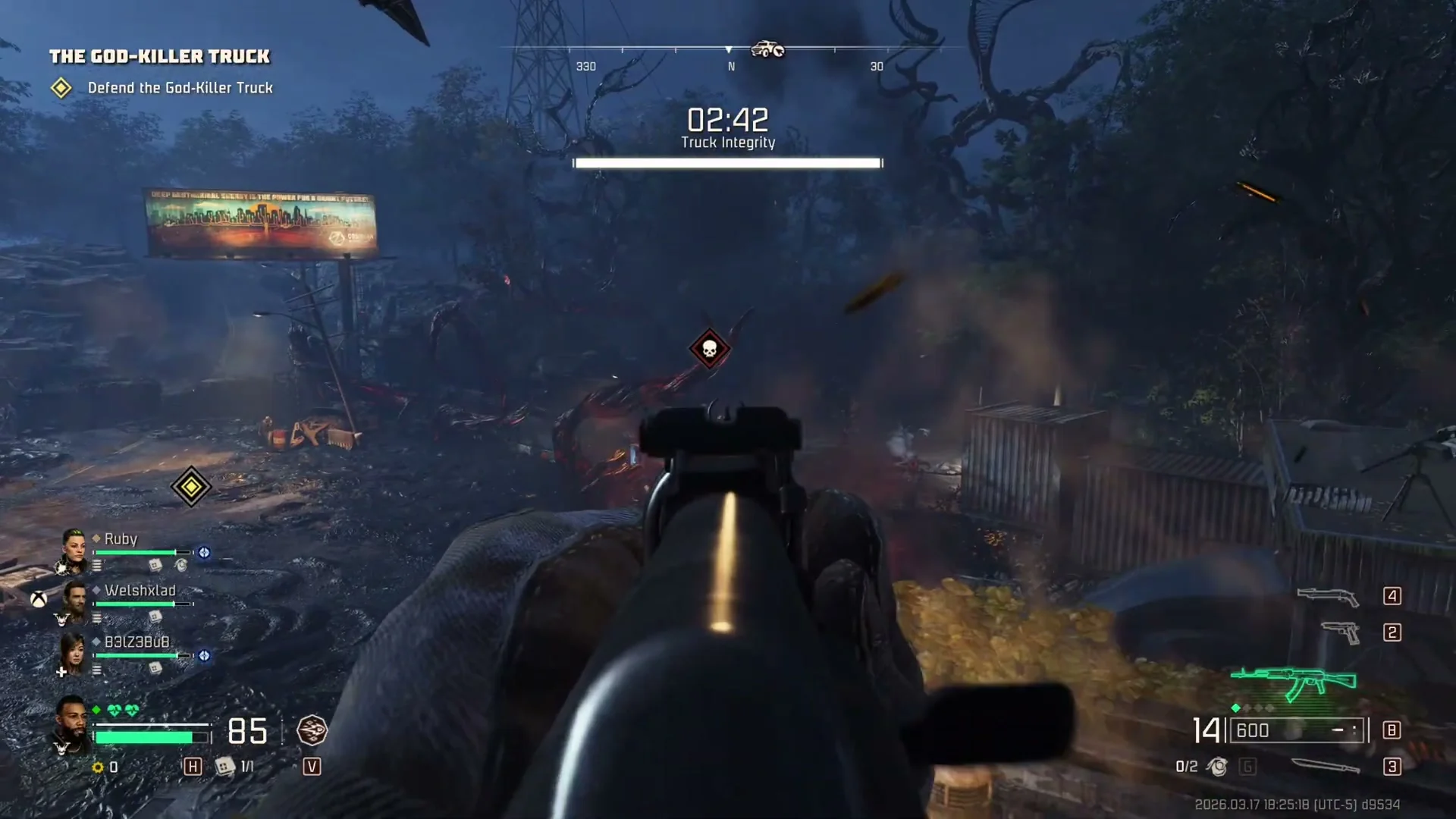
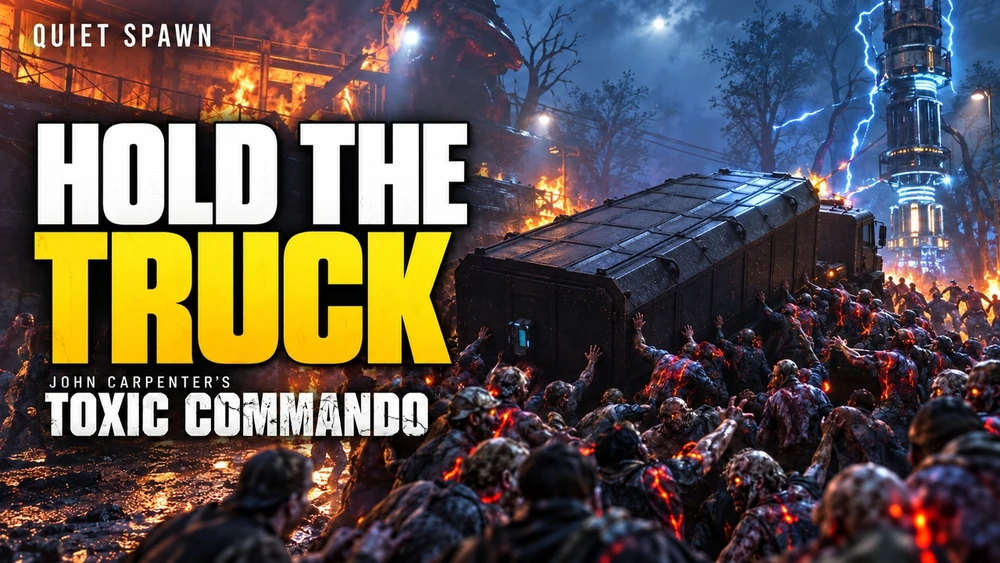
In Toxic Commando, the survivor has just been helped back up. Thirty-two seconds remain on the truck defence. The road is burning, and the unfinished job is still right there.
Both scenes make a crowd exciting. They give that excitement different shapes. World War Z’s Moscow defence is compelling because the swarm finds new ways into the space. Toxic Commando’s truck fight is compelling because the squad has a responsibility it cannot move out of trouble. That is the difference I would show the group before comparing the size of the explosions.
This comparison follows two credited recordings, not a current head-to-head playtest. The World War Z example is an October 2021 PC recording with Aftermath’s first-person view, ReShade and a reduced HUD. Toxic Commando’s example follows the mission analysed in our video and field notes. Neither establishes how varied a whole campaign feels or how either game runs on your hardware.
World War Z: watch the space stop protecting you
The mounted gun has a broad view of the snowy approach. From that position, the incoming infected look like a problem arriving from a recognisable direction.
The interesting turn comes when the player looks down beside the building. At about 16:20 in the source recording, bodies have gathered against the wall and more are trying to climb. You can read the pile as progress towards your position. Height is still useful, but it looks less permanent than it did a moment ago.
Later, attention moves indoors and upwards. Infected occupy the roof beams, then drop into the room. The perimeter is becoming harder to think of as a reassuring line between the survivors and the threat.
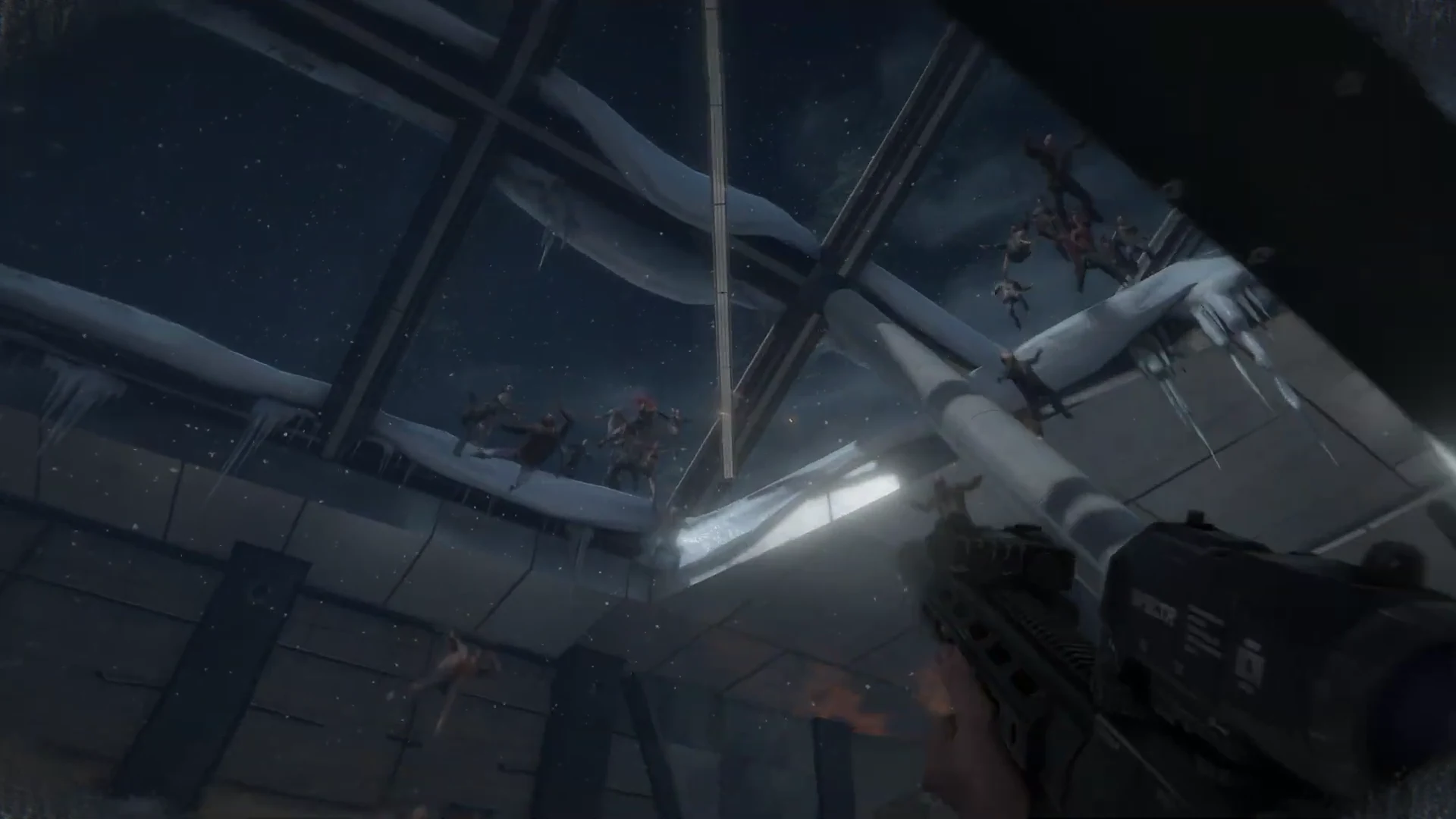
That is the invitation for a group that enjoys seeing a defence develop in front of them. The spectacle has a readable consequence: the crowd is changing where you need to look. It is more specific than wanting a screen full of targets.
The first-person camera makes the change of attention especially direct in this recording. Looking down at the wall removes the roof from the frame; looking up loses much of the floor. It also means this footage is a poor basis for judging how the standard third-person view feels. See the full scene analysis for the limits of that example.
Toxic Commando: the rescue happens inside another job
Before the defence, the squad has a road problem. Fuel, a vehicle and a winch help the journey continue. An obstacle becomes something the vehicle can pull apart; a difficult slope becomes somewhere a cable can help it climb.
Later, a different, much larger mission truck reverses the relationship. It needs the team to stay nearby and protect it for three minutes. Our Toxic Commando analysis follows that transition from travelling with a vehicle to defending one.
The timer gives the fight a clear shape. A player can step back, change their view or become incapacitated, but none of that pauses the remaining work. When the survivor gets back up, the truck still needs defending and the lost seconds remain lost.
For friends who like a recovery story, that overlap is the draw. Being rescued provides a quick burst of relief followed by an immediate reason to act. There is no need to invent an elaborate plan to explain the scene: people are down, the objective is still running, and the group has to keep going.
There is a visual tradeoff. Fire, bodies and effects can crowd the view. If a friend likes a clear outline around every immediate threat, send them the busy middle of the fight as well as the impressive final moments. The same spectacle that attracts one person may be tiring for another.
Choose the problem you want to be inside
| What caught your attention? | The scene to start with | What to look at next |
|---|---|---|
| Watching a huge crowd change the routes into a position | World War Z’s wall and roof defence | Whether you want the Aftermath first-person view shown in the recording |
| A shared objective that keeps running through a rescue | Toxic Commando’s truck countdown | The crowded view during the recovery, not only the finish |
| Practical vehicle work before the shooting gets loud | Toxic Commando’s earlier drive and winch | How much that kind of travel interests your friends |
| A readable threat that grows closer without a long explanation | World War Z’s rising pile | The change from distant approach to immediate access |
These are reasons to investigate the games, not rules about every mission. Both examples include crowded defences. The question is which recorded moment makes your group want to take part.
Check the versions before choosing the evening
Focus Entertainment’s release information confirms Toxic Commando’s up-to-four-player co-op and cross-play across PC, PS5 and Xbox Series X|S, with Steam and Epic included on PC.
Saber’s current FAQ gives World War Z’s campaign a broader console-generation range across PC, PS4/PS5 and Xbox One/Series, while original Switch remains separate. It also explains that the native current-generation upgrade requires Aftermath. Horde Mode XL has a narrower platform list than ordinary campaign co-op.
For the camera in our example, check Aftermath’s contents on the official store listing: the optional first-person view is part of Aftermath. A lower-priced listing with a familiar game name is not enough to establish that it includes the feature you want.
Use the two-game comparison for the practical differences. Then bring your exact stores and headcount into the group planner. Four people wanting the same game is a good start; four compatible copies is the next step.
Official setup references checked October 16, 2026. The editorial comparison concerns the linked recordings and does not measure current balance, performance or campaign length.
Check the pair side by side.
Put World War Z and Toxic Commando next to each other: players, platforms, compatibility and the kind of evening each offers.
Compare these two gamesThe Truck Stops. The Horde Doesn't. | Toxic Commando
Play or choose a chapter to load YouTube. Open on YouTube ↗
These are editorial starting points drawn from our linked scene analyses and official game information. We have not assigned review scores or claimed hands-on testing. The individual game pages identify recording dates, creators, source types, rights notes, check dates and limits. Our editorial method.