On this page
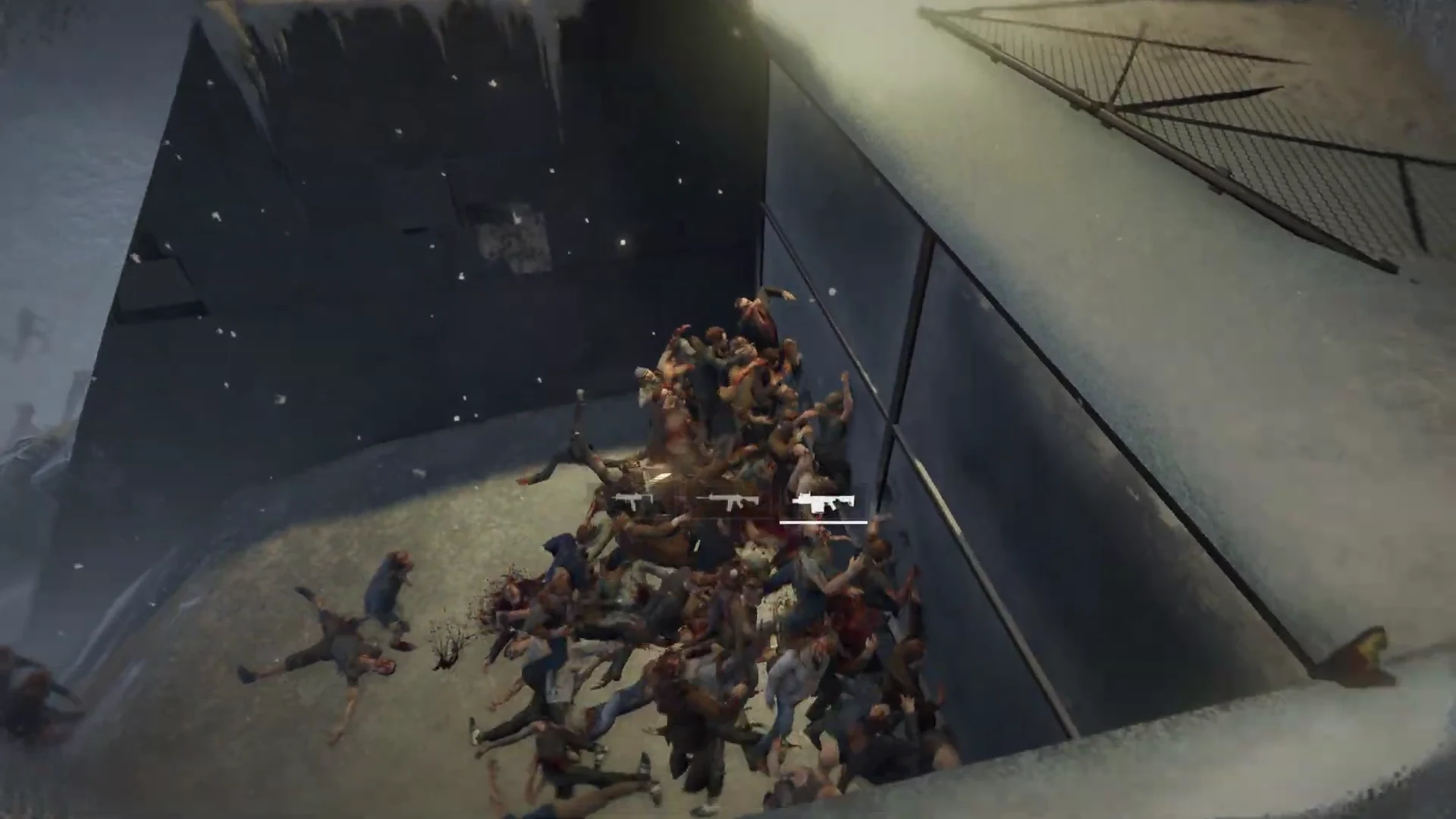
Look down from the ledge. The infected are no longer simply gathering beneath it. Bodies are piling against the wall, and more are climbing over them.
The height that gave the player a good view has become a distance the crowd is trying to close. It is a wonderfully readable threat: the taller the pile becomes, the less reassuring the ledge looks.
For your group: World War Z is worth investigating if you enjoy watching a large, visible problem develop, then reacting as it changes direction. The Moscow defence in this recording offers more than a crowded target. It keeps changing where the crowd can reach you.
This is No HUD Gameplays’ October 2021 PC recording, using first-person view, ReShade and a largely removed HUD. It illustrates an encounter, not the current game’s default appearance, interface or performance. First-person play is an optional feature of World War Z: Aftermath, not a feature to assume from every edition bearing the World War Z name.
The crowd changes the meaning of the wall
Earlier in the defence, the player uses a mounted gun overlooking the snowy approach. That view makes the incoming mass easy to locate. The interesting change happens when the camera looks almost straight down beside the building.
At around 16:20 in the original recording, the pile is pressed against the wall. You can distinguish the bodies already gathered below from those trying to get higher. The swarm has a shape, and that shape communicates progress towards the ledge.
I like how little explanation this needs. You do not need an enemy name or a damage statistic to understand why looking away feels consequential. The environment supplies a visible question: will that barrier continue to separate you from the crowd?
The clip also makes a useful distinction between spectacle and scale. A wide shot of distant infected is impressive. A rising pile next to the player gives that size a practical consequence.
Then the ceiling becomes an entrance
Later, the fight moves our attention indoors. The player looks up into the roof structure. Infected are visible on the beams, then several drop into the room beneath them.
The next entrance is overhead.
Select a detail to highlight it in the frame.
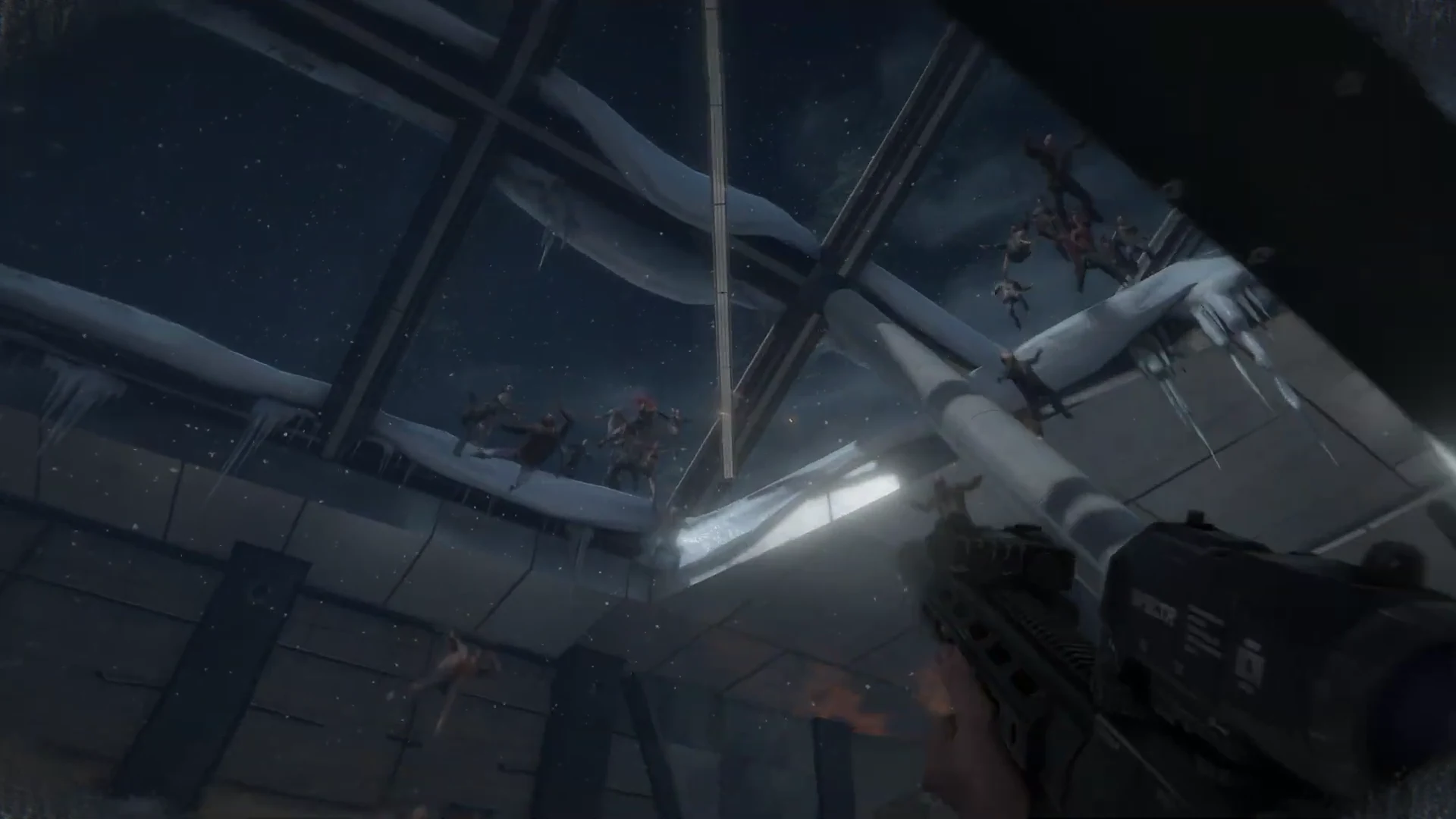
The whole picture
Read the figures on the beams, then the bodies below the right-hand beam, then the player’s raised weapon. Together they explain why this view has turned away from the ground-level approach.
The roof holds the next threat.
Several figures occupy the beam above the room. The architecture gives them a position the player has to notice, extending the fight beyond the doorway or floor in front of them.
The boundary has already been crossed.
On the right, bodies appear below the roof structure. In the recording they fall into the room. The still places the threat between the overhead route and the space the survivors occupy.
Looking up changes what you can watch.
The first-person camera and rifle are directed towards the roof. Much of the floor is outside this frame. That is a visible limit of this viewpoint, not a claim about how every team should aim.
The two scenes belong together because they change the same assumption. A wall and a roof normally help define where a room ends. Here, both become ways for the encounter to continue. The player has to reconsider the space, not just keep shooting at the original approach.
First-person framing makes that change particularly direct in this recording. Aiming down at the pile removes the roof from view; looking overhead removes much of the floor. It is a tradeoff in what this camera shows, not proof that one perspective is more difficult or that every team should use it.
Which kind of zombie evening do you want?
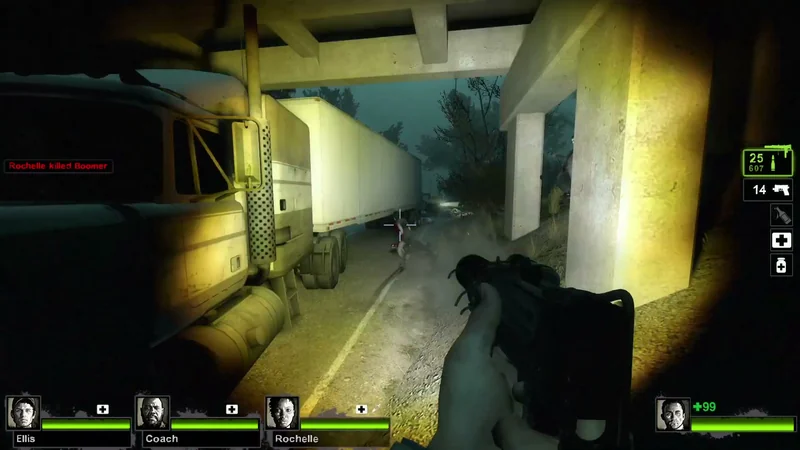
Our Left 4 Dead 2 example centres on an individual survivor losing control and needing somebody else to respond. The memorable question is who can reach the person who is caught. World War Z’s wall scene instead makes the approaching mass itself the immediate problem.
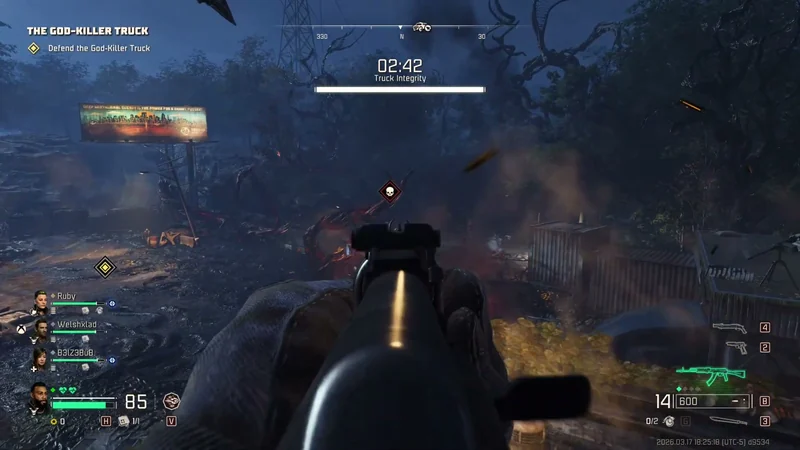
In Toxic Commando’s truck defence, a shared objective and a visible countdown give the crowd a focal point. The Moscow scene offers another reason to enjoy a defence: watching the routes into a position change as the fight develops. These are distinctions between the recorded moments, rather than claims that the games only do one thing. Our World War Z vs Toxic Commando comparison follows the difference from the first warning to the buying questions.
The official Aftermath description supports up to four-player co-op, with AI teammates available for solo play. That lets smaller groups investigate it too. Our recording does not establish how many survivors were controlled by humans, so it is evidence of the encounter’s layout, not of four friends executing a coordinated plan.
Choose it for the sight of a crowd turning the surroundings into a problem. Saber’s current FAQ confirms campaign cross-play across PC, PS4, PS5, Xbox One and Xbox Series X|S; original Switch is separate. Aftermath’s first-person option matters if this view is what caught your attention. Confirm that edition before buying for the camera shown here.
Source: No HUD Gameplays’ original recording, October 14, 2021. Creator recording licensed under CC BY 3.0; underlying game rights remain with their respective owners. Game by Saber Interactive; official game page.
Put it on your group’s radar if…
Friends drawn to visible, developing swarm threats and a defence that changes where they need to look.
Keep in mind: The 2021 PC recording uses ReShade and reduced HUD. Its optional first-person view requires Aftermath. Original Switch is a separate edition and does not join PC/console cross-play.Can your group play together?
Up to 4 people in the mode covered here. Base cooperative campaign; excludes Horde Mode XL, PvP and World War Z VR.
Online versions, exceptions and official sources
Each row lists versions documented as compatible. For a mix that spans rows, use the group checker below; an unlisted combination may need another source check.
- Group 1PC · Steam · PC · Epic Games · PC · Microsoft / Xbox app · PlayStation 4 · PlayStation 5 · Xbox One · Xbox Series X|S
- Group 2Nintendo Switch
Base campaign/ordinary co-op only. Aftermath adds first-person mode and missions; do not advertise every expansion as included. Horde Mode XL is limited to PC, PS5 and Xbox Series, so it cannot inherit this broad pool. PS5/Series native upgrade requires Aftermath. Switch has no crossplay with PC/other consoles. Local wireless on Switch is not single-console couch co-op. Switch 2 backward-compatibility networking was not established. For native current-generation upgrade, the publisher requires Aftermath ownership.
Versions absent from this review need a separate check. They are not automatically unavailable. These notes do not cover mods, cloud-streaming services or every game mode.
- Saber names Steam/Epic/Microsoft PC and console availability/crossplay; original Switch is separate. Aftermath required for free native current-generation upgrade; Horde XL has narrower hardware scope. ↗
- Publisher verifies solo/four-person co-op. Base game is third-person; Aftermath adds optional first-person and extra missions. ↗
- Nintendo publisher listing: original Switch one player, local wireless one to four, online two to four. ↗
For the first-person view, look for Aftermath.
Match the footage
The first-person option belongs to Aftermath. If that viewpoint is what caught your eye, choose an Aftermath purchase option rather than assuming the base World War Z listing includes it.
Already own it?
On Steam, the Aftermath Upgrade is an add-on that requires World War Z. New buyers can compare the base game and full Aftermath purchase options on the main store page.
Build your squad
Aftermath supports four-player co-op, with AI teammates for solo play. Check the current platform guidance for your group; the Nintendo Switch release should not be assumed to include the same edition or features.
Exact add-ons mentioned here
We have not reviewed an add-on listing for your selected version. Check the matching platform at the official game store before buying.
Steam. Add-on: the base game is required.
Check this add-on at Steam ↗Standard store link. We earn no commission from this link.Buying notes checked October 15, 2026. Confirm your edition, activation country and online requirements at the store.
Sources, footage & what this article covers
Recording: “World War Z - Battle of Moscow [First Person View] (4K 60 FPS / NO HUD)” by No HUD Gameplays. Date / context: October 14, 2021. Original recording ↗
Source recording listed under CC BY 3.0. Website stills are selected frames, resized and converted for the web. The article adds Quiet Spawn’s original scene analysis. Game imagery belongs to its respective owners.
Game information checked on . Official game information ↗. Older footage may differ from the current game. Mood labels and group-fit suggestions are editorial interpretations.
Read how we cover games and how store links work.