On this page
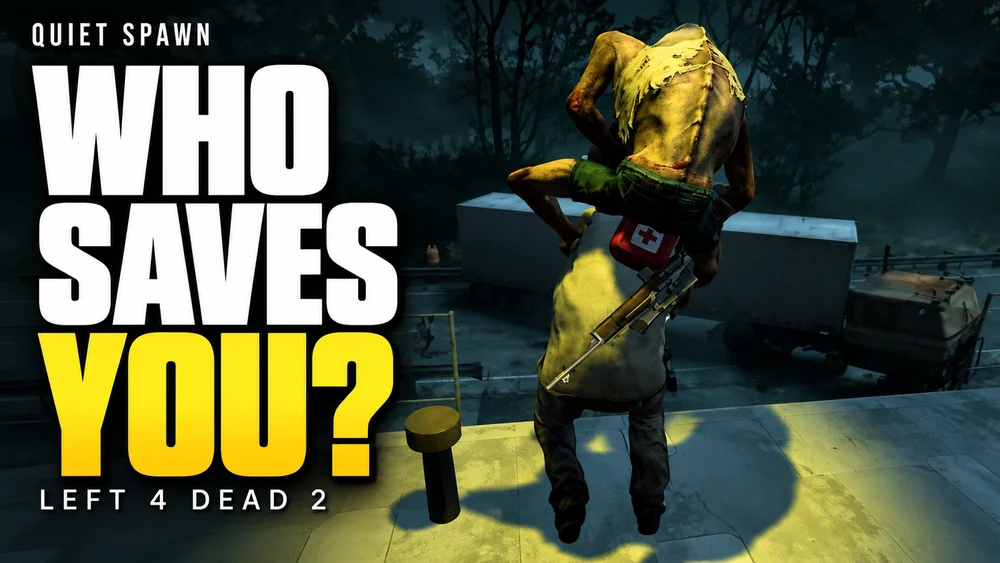
The motel roof looks like a good place to be. You can see across the courtyard, the rifle is ready, and the team is close. Then a Jockey lands on the survivor and takes all three advantages apart.
The rifle leaves the screen. The survivor is steered across the roof and down into the parking area. Rochelle eventually breaks the hold, but being near the team has not made the rescue instant.
That delay is what makes this Dark Carnival opening interesting. A player who was choosing targets is suddenly looking for help. Good aim cannot finish the job while the weapon is unavailable; someone else has to make shooting possible again.
For your group: this is a useful scene to start with if your friends enjoy fast action and sudden reasons to look after each other. The catch is part of the appeal: sometimes you lose control of the situation and need another survivor to respond.
Distance changes meaning during a rescue
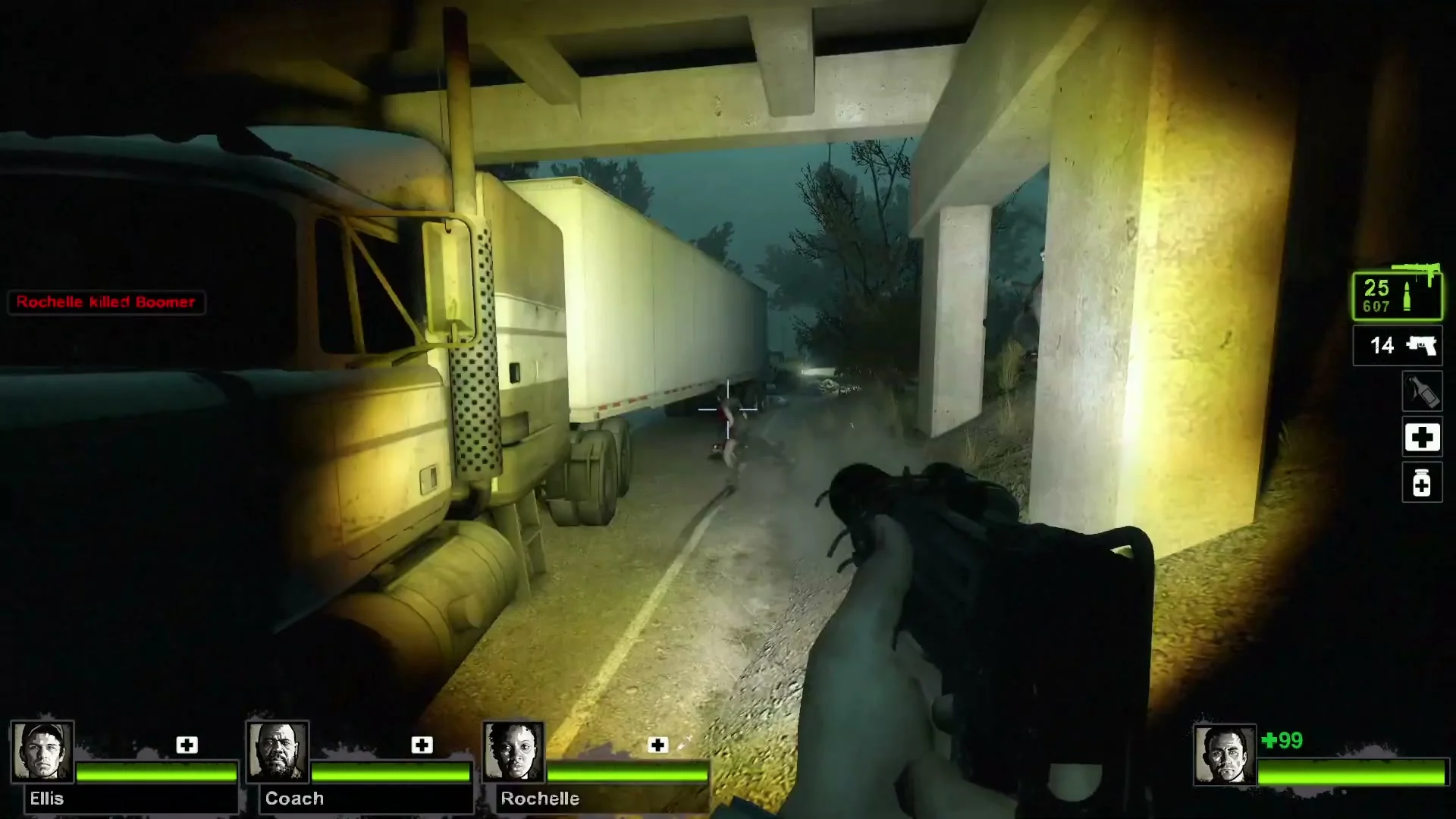
The opening highway in Dark Carnival offers room to move, while abandoned vehicles keep breaking up the view. At the motel, the roof gives the player a broader look across the courtyard. For shooting at a distant enemy, that can be helpful.
During a grab, the same layout creates another question. Can a teammate get a clear opportunity to help? In this run, the group is nearby, yet the Jockey still has time to pull the survivor off the roof and cost them health.
The rescue matters because the interruption is so immediate. A useful rooftop position becomes a route the survivor is being dragged along. Watching from that viewpoint, you start looking for a teammate as urgently as you were looking for a target.
The room is still there. Reading it is harder.
Inside the motel, attention moves from a doorway to an infected climbing through a window. Then a Boomer effect washes over the view. The player can still move and fire, but recognising familiar shapes becomes more difficult.
Watch the room before and after the effect. The doorway, nearby team members and lines of movement remain part of the task. The difference is how much visual information is available to follow them.
The game keeps asking the team to do a new job in the middle of the old one.
Later, another Jockey catches the survivor and Ellis gets them free. Soon after, a Charger has Ellis. The recording does not need a grand plan to make support feel urgent; it keeps producing small situations that require a response.
A quiet moment still has somebody working
One of the most telling details is a healing pause. The progress bar fills while Rochelle fires nearby. The pause is useful to one survivor, but the fight has not become idle for everyone else.
This is the kind of moment that distinguishes shared space from meaningful cooperation in our analysis. The actions are connected. One member needs time; another is still dealing with what could interrupt it.
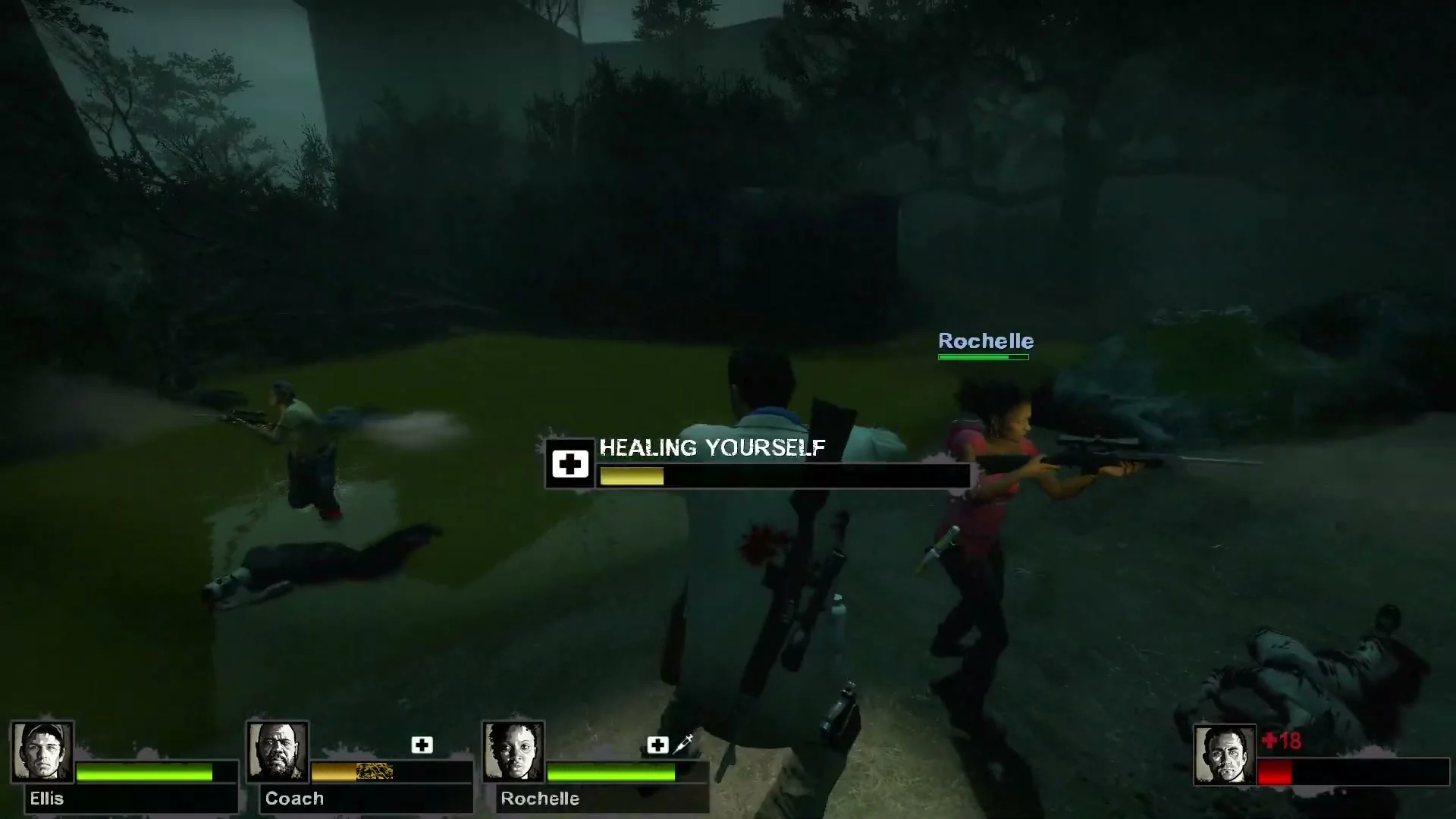
When the safe-room door closes, it feels like a payoff because the chapter has repeatedly threatened to break the group’s progress. The door ends that chain of interruptions.
Why the next run need not tell the same story
There is a useful bit of context beyond this recording. Valve describes an AI Director that adjusts elements of the experience, including enemy population, to the team’s performance. That helps explain why a chapter can be a setting for different encounters rather than a fixed sequence to memorise.
It does not tell us why this particular Jockey or Charger appeared. The footage shows the result, not the Director’s decisions. What we can observe is a chain of interruptions that gives the same journey several different demands.
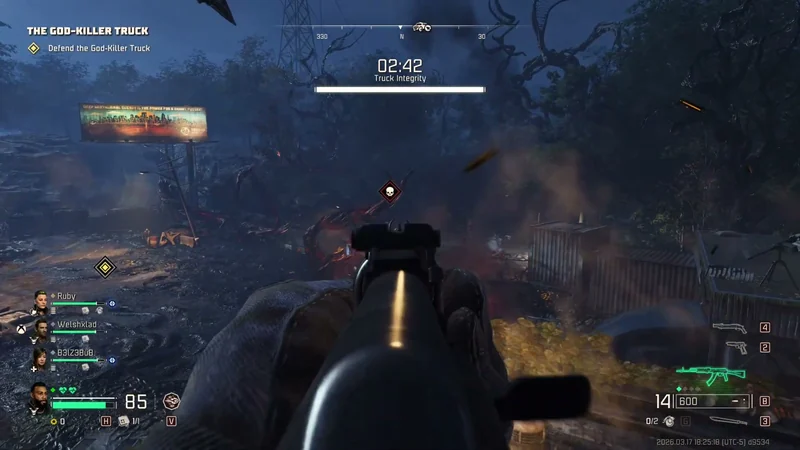
Compare that with the stationary truck in Toxic Commando. There, the object of the defence stays visible while emergencies compete around it. Here, the next urgent responsibility can be a survivor who was moving comfortably beside you a moment ago. Choose between those scenes by asking whether your friends prefer rallying around a clear objective or reacting when the team’s immediate need changes.
Is needing a rescue part of your idea of fun?
We would shortlist Left 4 Dead 2 for friends who like the responsibility changing hands quickly. Aim matters, but a grab, a blocked view or a healing pause can make somebody else’s situation the most urgent thing on the screen.
That can also frustrate someone who wants uninterrupted control of their character. The motel scene is useful precisely because it shows the interruption and the time it takes to resolve. Show the whole rescue to your friends, not just the moment the rifle returns.
This run does not establish which survivors are controlled by people, its difficulty setting or its mods. It demonstrates the rescue and cover mechanics without proving how a particular human group will use them.
For the next evening after the safe room, read five directions beyond Left 4 Dead 2. Or compare it with Toxic Commando: a teammate becomes the urgent objective in one scene; a truck keeps the squad’s attention in the other.
Watch the scene unfold
Play or choose a chapter to load YouTube. Open on YouTube ↗
Put it on your group’s radar if…
A group that wants fast changes of responsibility: shoot, rescue, cover, move.
Keep in mind: Our example follows one Dark Carnival opening. It does not establish the difficulty, mod setup or number of human players.Can your group play together?
Up to 4 people in the mode covered here. PC Steam cooperative campaign, unmodified.
Online versions, exceptions and official sources
Each row lists versions documented as compatible. For a mix that spans rows, use the group checker below; an unlisted combination may need another source check.
- Together onlinePC · Steam
This record covers the PC Steam campaign. Xbox 360/backward-compatible editions are outside this review, not declared nonexistent. Versus and modded capacities do not determine the campaign limit.
Versions absent from this review need a separate check. They are not automatically unavailable. These notes do not cover mods, cloud-streaming services or every game mode.
Buy the rescue run you came to see.
The sequel is its own purchase
The Steam page sells Left 4 Dead 2 on its own and in larger bundles. The Dark Carnival run in our field notes is in Left 4 Dead 2; buying a Valve collection is a separate choice.
Keep the mode clear
Our recommendation concerns the four-survivor co-op campaign on Steam PC. Versus, Survival and Workshop modifications are other ways to play; their rules should not be used to promise extra campaign places.
Old requirements need a second look
The page still displays older Windows requirements, followed by a notice that the Steam client needs Windows 10 or later. Read both before buying for an old computer. We have not benchmarked the game on your hardware.
Buying notes checked October 15, 2026. Confirm your edition, activation country and online requirements at the store.
Sources, footage & what this article covers
Recording: “Left4Dead 2 Dark Carnival #1 (No Commentary) 1080p 30fps | Free to Use” by @gamingonymax. Date / context: June 13, 2026. Original recording ↗
Source recording listed under Creative Commons Attribution. Website stills are selected frames, resized and converted for the web. The article adds Quiet Spawn’s original scene analysis. Game imagery belongs to its respective owners.
Game information checked on . Official game information ↗. Older footage may differ from the current game. Mood labels and group-fit suggestions are editorial interpretations.
Read how we cover games and how store links work.